Within the intensely competitive realm of today's pro-level oversteer competition, podium finishes is not merely purely a product of sheer engine power or pilot bravado. Rather, it is now a complex science that necessitates a scrupulous fusion of picking a time-tested chassis, equipping it with the most precise competition parts, and, most essentially, comprehending its real-time performance on the circuit through advanced suspension tuning applications. This comprehensive guide functions as your master plan starting from the very first concept of a competition vehicle right through to the last data-informed adjustments that elevate a capable vehicle into a consistent champion. We will thoroughly explore the methodical process of chassis dynamics adjustment, illustrating how a modern drift tuning app like GripDial removes assumptions and delivers exceptional insight into your vehicle's actual behavior.
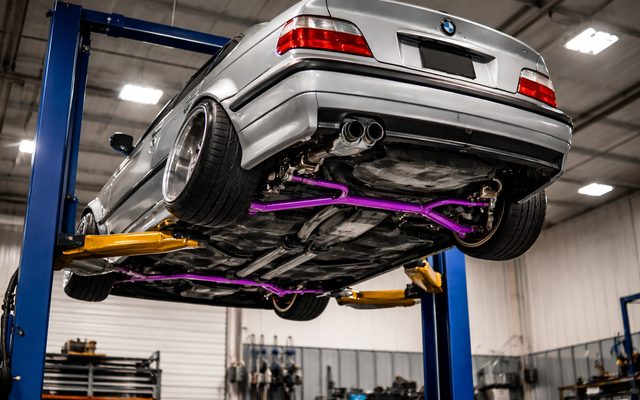
The cornerstone of any successful drift car is, without question, the platform itself. Several platforms have achieved legendary standing within the global drifting scene due to their natural weight distribution, robust design, and the immense ecosystem of performance components available. Choosing the right starting point is the initial and most significant choice a builder will make. For instance, the the E36 generation BMW is universally acknowledged as one of the best overall cars for drifting of history. Its excellent 50/50 weight distribution, alongside a rear-wheel-drive configuration and robust inline-six engines, forms a car that is at once accessible for novices and incredibly capable in the possession of a pro driver. The successor of this philosophy, the E46 model BMW, refines these attributes with a increasingly sophisticated chassis, broader wheel track for greater stability, and even a greater degree of turning capability directly from the factory. Another dominant option in the professional scene is the C6 generation Corvette.
This muscle-derived performance car introduces a unique combination of advantages to the sideways sport, including a light aluminium frame, a backwards-positioned drivetrain component that helps create an ideal balance, and the colossal low-end power of a large-displacement GM LS engine. This blend makes it an complete monster on track, capable of entering and holding long angles with seemingly easy use of acceleration. For drivers seeking outstanding bang-for-the-buck, the 350Z model Nissan stands out as a top-tier choice. It arrives from the factory with a robust platform, a decent factory LSD, and the free-revving VQ series motor that provides ample power and torque for mastering and advancing in the activity. Its newer version, the Nissan Z34, brings further refinements in structural rigidity, suspension design, and outright engine power, solidifying its place as a common choice among serious pilots. Additional iconic platforms that warrant attention encompass the lightweight Wankel-engined Mazda FC RX-7, the most popular S13 Silvia/240SX, the American SN95 generation Mustang, the more recent E90 3 Series, and the small yet surprisingly fun and forgiving MX-5 Miata. Each of these chassis provides a unique array of traits, difficulties, and potentials, but they all have in common the fundamental elements necessary to be transformed into a serious drift car.
However, choosing the optimal chassis is only the beginning. To release the complete performance of any of these cars, significant upgrades to the steering geometry and suspension systems are completely essential. This is where the world of precision tuning components comes into sharp focus. The single most game-changing upgrade for a purpose-built drift car is the installation of a high-performance angle modification kit. These advanced systems, like those engineered by specialist companies like SLR Speed, are created to dramatically enhance the vehicle's maximum steering angle. A standard production vehicle is severely constrained in how far its tires can rotate, a engineering compromise for public road use. In drifting, conversely, maximum countersteering is frequently required to manage and maintain a angle. An angle kit substitutes the stock uprights, linkages, and sometimes A-arms with parts that allow the front tires to attain degrees of turn over 70 or even 80 degs, as opposed to a typical OEM setting of around 40 to 50 °.
This vastly expanded capability provides the driver with dramatically enhanced control during a angle, making it much more straightforward to initiate a slide, maintain it through a long turn, and switch seamlessly from one angle to the opposite. The contrast in controllability is nothing short of revolutionary. Combined with a properly specified steering kit is the just as essential upgrade to the chassis's suspension. Generic or including expensive sport coilovers are simply not designed for the specific and brutal demands of drifting. A drift-spec pair of adjustable dampers is crucial. These specific suspension components have specific piston tuning and spring stiffness that are designed for the extreme weight transfer that is typical of sliding. When a driver initiates a angle, the car's inertia is thrown forcefully to the front of the turn. Optimal competition coilovers manage this transfer in a predictable manner, allowing the car to settle promptly and giving the pilot clear feedback through the steering wheel and cockpit. They also allow for exact tuning of ground clearance, rebound and compression stiffness, and cross-weight, which are all integral aspects of fine-tuning the chassis's handling to a given track or competition approach. In combination, a high-quality angle modification system and a properly chosen system of competition suspension units form the absolute hardware base upon which all future refinement is based.
Once the essential components is in place, the following essential phase in the build is the detailed tuning of the vehicle's alignment. This is the realm of chassis dynamics adjustment, a process that can appear intimidating to the uninitiated but is, in fact, the secret to converting a collection of fast components into a unified and predictable machine. The most debated element of suspension geometry for sliding is undoubtedly camber angle. Camber angle is the tilt of the tire relative to the vertical line when observed from the front of the chassis. When the top edge of the wheel is angled towards the car, this is called camber-in. In oversteer driving, inward-leaning wheels on the steering wheels is universally used and is considered essential. The purpose is deeply related to physics.
When a car is going around a bend at limit angles, the chassis rolls to the outer of the bend. This chassis roll forces the outer front tire to diminish its ideal grip area with the track surface. By applying negative camber, the wheel is pre-angled to counteract this roll. As the vehicle tilts into the turn, the outside front tire becomes more upright with the road surface, increasing its bite at the precise time when it is absolutely essential for steering authority. Commonly, front angles for a competition drift machine vary from approximately -3 degrees to as high as -5 degrees or even more, based on the parameters of the chassis geometry, compound choice, and driver style. The back tires also utilize negative camber, but the angles are typically more conservative and subtler than the front. Too much camber at the back can make the car excessively tail-happy and challenging to predict on acceleration input, as it shrinks the usable contact patch of the driving wheels during straight-line acceleration. Thus, rear angles are frequently in the vicinity of -1 degree to car alignment tuning -3 degrees, achieving a delicate balance between providing enough lateral traction to help in initiating and holding the angle while still preserving effective traction for power-down the corner. Camber is just one component of the more complex tuning picture, which vehicle dynamics tool also involves toe angle, caster angle, and suspension-induced steering modification.
Toe setting is the orientation of the tires when looked at from above. Positive toe means the leading edges of the wheels are closer together than the trailing edges, while outward toe means the opposite. For oversteer, a slight amount of front negative toe is frequently used to improve the turn-in steering feel, making the vehicle feel more responsive and willing to initiate a oversteer moment. Rear toe is generally set to zero or a incredibly small amount of toe-in to encourage stability under throttle. caster angle is the longitudinal or backwards inclination of the kingpin axis when viewed from the side-on of the vehicle. Increased caster improves steering feel and stability stability, and it additionally increases inward lean effect during turning, which is extremely advantageous. Setting these parameters is a intricate interplay where a change to a single setting can and often will impact the others. The conventional approach for setting a vehicle's suspension geometry for drifting has historically been a tedious affair of guesswork and adjustment. A tuner or team would introduce a adjustment based on a hunch, drive the vehicle on track, depend on the driver's personal perception and feedback, and then make an additional adjustment. This loop would iterate time after time until the car felt "right" or the scheduled track session was exhausted. This system is not only extremely wasteful in terms of time and tires, fuel, and parts, but it is furthermore fundamentally flawed.
Human feel is a infamously inconsistent measurement tool, affected by countless factors such as tiredness, evolving track grip levels, temperature, and simply the mindset of the operator on that given day. What feels "loose" on one run might feel "tight" on the next lap, causing confusing information and counterproductive tweaks. This age-old problem in chassis setup is specifically where state-of-the-art technology has stepped in to revolutionize the process.
The advent and adoption of sophisticated vehicle dynamics tools has brought about a completely new age for engineering and refining high-performance drift cars. These platforms, showcased by cutting-edge solutions like data acquisition tools, work by actively recording the live physical movement of the vehicle as it is operated on the course. In contrast to relying on personal feel, these systems acquire objective data on critical variables such as suspension travel, corner velocities, acceleration forces, steering angle, and throttle and brake input. This collected telemetry is then interpreted by sophisticated software that can graph and analyze the metrics in a actionable manner. For the first time, engineers and crews can visualize specifically what the car is doing at any given moment of a slide. This ability changes the complete suspension tuning procedure. Imagine the specific challenge of setting the front axle negative camber for a given vehicle. Instead of making a change from -3 degrees to -3.5 degrees and then driving many laps to try and "perceive" a change, a telemetry system can give real-time and clear data. The software can display graphically how the suspension's grip is behaving during the critical phases of a angle: turn-in, mid-corner, and switch. It can demonstrate if the present angle is allowing the loaded tire to achieve maximum grip or if the compound is over-stressed on its outside shoulder.
The system can after analysis provide data-driven suggestions for change. Perhaps the telemetry shows that the tire is even overloading its outer shoulder at -3.5 degrees of camber, implying that a move towards angle, say -4 degrees, might be warranted. Conversely, the information might reveal that the tread is failing to coming up to optimal operating temp or that the inner shoulder is wearing too quickly, which could point to that there is excessive angle and a modest reduction back to -3.2 degrees would be better ideal. This degree of granularity and actionable insight was simply impossible in the era of pure mechanical setup.
The effect of utilizing a comprehensive vehicle dynamics tool extends far beyond only dialing in camber angles. It serves as an priceless damper adjustment manual that is specific to your particular vehicle. When fine-tuning the shock absorber values on your adjustable dampers, instead of using imprecise guidelines or replicating another car's setup, you can utilize the telemetry to analyze how the chassis is performing in relation to your adjustments. The application can graph the suspension travel data over a section of track, revealing if the coilovers are managing the chassis motion properly or if they are causing the car to oscillate too much after a direction change. It can help in identifying problems like bottoming out or excessive extension, allowing you to make educated adjustments to spring preload, rebound/compression settings, or ride height. This methodology extends similarly to the complex art of car alignment tuning. Beyond camber, the tool can give analysis into how changes to toe settings and caster angle are affecting the chassis's stability during specific phases of a slide. For example, it can help you to determine the best amount of front toe out for your particular steering rack setup and driving approach by showing the quickness of turn-in reaction and the consistency of the car at full countersteer. This turns the tool an extremely effective performance optimization handbook that is actively calibrated by the live performance of your specific chassis on the tarmac. It elevates the complete project from a dark art into a repeatable engineering process.
Additionally, the application of a tool like GripDial is not confined to professional engineers with extensive resources. For the amateur driver, it serves as an incredible equalizer. It effectively offers the driver with the insight of a expert dynamics engineer without needing the associated cost. It drastically shortens the tuning process by giving definitive answers to challenges that would otherwise take seasons of trial and error to solve. A builder can see how their particular vehicle responds to different settings, developing a deeper comprehension of suspension theory in the process. It additionally opens up professional chassis dynamics concepts, permitting anyone with the ambition to perfect their vehicle to accomplish it in a systematic and productive way. This is notably valuable in a activity like sliding, where engineering knowledge has in the past been a drift suspension tuning guide closely guarded asset among professional teams. Today, that knowledge can be in the garage of every dedicated driver.
In summary, the process to engineering and optimizing the ideal competitive drift machine is a comprehensive endeavor that smoothly blends proven engineering knowledge with 21st-century telemetry solutions. It starts with the informed pick of a proven chassis, followed by the installation of critical performance components like maximum-angle steering angle kits and correctly specified drift-spec coilovers. The journey then progresses into the precision phase of alignment optimization, where parameters like camber, toe setting, and caster are precisely configured to suit the vehicle's upgraded geometry and the driver's personal technique. The final step, and what genuinely separates the contemporary approach from the traditional methods, is the integration of a powerful suspension tuning application. This system removes the approximation and inefficiency of solely subjective setup by giving objective, live information on how the chassis is actually performing. It serves as an incredible engineering partner, a comprehensive alignment optimization handbook, and a all-in-one vehicle dynamics tool. In unison, this complete philosophy leads to that all aspect of the drift machine—from the choice of the platform to the last adjustment on the coilover—is refined for maximum performance on the competition venue. It embodies the complete maturation of the sport of oversteer driving, connecting physical car control with surgical suspension engineering to forge the ultimate effective vehicles imaginable.